MiMentor
Hidden Cost of Poor Football Comms

Hidden Cost of Poor Football Comms

The Hidden Cost of Poor Communication in Football Organisations

Poor communication in football rarely appears as one obvious failure. 

More often, it shows up quietly. A coach misses an update. A CPD resource is shared with one group but not another.

A new member of staff joins and has to piece together the club’s methodology through conversations, old documents and personal interpretation. A player receives slightly different messages as they move between age groups, not because staff disagree, but because the information around them is not connected. 

In isolation, these moments may seem small. Across a full football department, they become significant. 

In elite environments, communication is not simply an operational issue. It shapes clarity, alignment and culture. It influences how quickly staff understand expectations, how consistently coaches deliver the methodology and how effectively learning is shared across the organisation. 

For senior leadership teams, the question is no longer whether communication matters. It is whether the club has the right systems in place to make communication visible, consistent and useful. 

Communication Is A Performance Issue 

Modern football clubs are complex organisations. 

Academies, men’s teams, women’s teams, analysis departments, sports science, medical teams, player care staff and senior leaders all contribute to the performance environment. Each department holds valuable knowledge. Each interaction can influence how players and staff experience the club. 

That level of collaboration creates opportunity, but it also creates risk. 

When communication is clear, departments work from shared principles. Coaches understand the methodology. Staff can access the resources they need. Learning is captured and revisited. Players receive consistent messages as they move through the pathway. 

When communication is fragmented, even strong people can end up working in disconnected ways. 

Sir Alex Ferguson once explained that one of the biggest lessons he learned in management was the need to communicate effectively with the entire dressing room, not just a select few. In modern football organisations, that principle extends beyond players. Communication must reach coaches, support staff, analysts, academy teams and leadership groups if an environment is going to stay aligned. 

This is why communication should be viewed as part of performance, not administration. A club’s ability to communicate well affects how quickly knowledge travels, how accurately ideas are understood and how consistently standards are delivered. 

The Real Cost Is Often Hidden 

The challenge is not unique to football. 

Grammarly’s 2024 State of Business Communication report, produced in collaboration with The Harris Poll, found that professionals now spend 88% of their workweek communicating, including 19 hours on written communication alone. The same report found that 84% of leaders are communicating across more channels than ever before. 

That matters because more communication does not automatically mean better communication. 

In a football context, the number of channels has grown quickly. Staff may be working across email, WhatsApp, shared drives, video platforms, meeting notes, analysis systems and informal conversations. Each tool may serve a purpose, but without a clear structure, information can quickly become scattered. 

The result is not always dramatic. It is often a slow loss of clarity. 

Time is spent searching for previous resources. CPD learning is not followed up. Session ideas are difficult to revisit. Staff development activity becomes hard to track. New coaches must ask multiple people for information that should be easy to access. 

Poor communication does not only create confusion. It creates friction. 

The lesson for clubs is simple: if communication is left entirely to informal habits, important learning will be missed. 

Elite Environments Need Shared Understanding 

Jürgen Klopp once described leadership by saying: “I need experts around me.” He also stressed the importance of empathy, understanding people and giving them support. 

That idea is highly relevant to modern football organisations. High-performance environments are not built by one person holding all the knowledge. They are built by experts working together with clarity and trust. 

But expertise only becomes powerful when it is connected. 

A Head of Coaching may set a clear development direction, but that direction must be understood by every coach. An academy may have a strong methodology, but that methodology must be accessible, discussed and applied consistently. A CPD programme may deliver excellent insight, but that learning must live somewhere beyond the room it was delivered in. 

This is where many clubs face a practical challenge. 

They do not lack knowledge. They lack a connected environment for that knowledge to be shared, stored and developed over time. 

Where MiMentor Fits 

MiMentor has been built around the belief that coach education and staff development should be accessible, connected and easy to engage with. 

For clubs and organisations, the platform creates a central place to host and share education content, courses and resources for coaches, staff and members. That is important because communication improves when people know where to go for information. 

Instead of development activity being spread across emails, message threads, meeting notes and individual files, MiMentor gives clubs a more structured environment for learning and collaboration. 

Resources can be stored in one place. CPD activity can be shared more consistently. Coaches can access learning at a time and pace that suits them. Communities can be created to support discussion, connection and shared development. 

For senior leadership teams, this creates greater visibility. 

A Head of Coaching, Academy Manager or Technical Director can begin to understand not just whether learning is happening, but how it is being accessed, shared and embedded across the organisation. 

The value of a platform is not that it replaces conversation. 

It gives conversation somewhere to go next. 

Better Communication Builds Better Culture 

Culture is often spoken about in football as if it is created through values on a wall or messages delivered at the start of the season. 

In reality, culture is shaped by daily habits. 

It is shaped by how staff communicate, how learning is shared, how clearly expectations are understood and how consistently people are supported. If communication is fragmented, culture becomes harder to sustain. If communication is connected, culture becomes easier to build. 

Clubs that want to build stronger environments need more than content. They need a place where knowledge can be hosted, accessed, discussed and developed over time. 

MiMentor provides that space. 

Not as another layer of administration, but as a platform that helps clubs bring coach development, learning resources and staff communication into one connected environment. 

Because in elite football, the hidden cost of poor communication is rarely just confusion. 

It is lost learning, missed alignment and unrealised potential. 

MiMentor Platform Helping Coaches Grow

Are you a coach keen to learn and develop you knowledge in today’s modern game? As a member of MiMentor Explore, you’ll get access to CPD courses, resources, webinars and learning content used by clubs and coaches from elite academies to grassroots. You’ll be able to join our community of coaches and share ideas and gather insight from others, and also be able to ask questions to our coaching Mentors who are there to support you on your coaching journey.

Want to learn more about MiMentor Explore, click here…

Football’s Need For Knowledge-Sharing

Football’s Need For Knowledge-Sharing

Why Football Clubs Need Internal Knowledge-Sharing Systems 

Across professional football, coaches and support staff are exposed to an endless stream of analysis, research, CPD opportunities, performance data and shared experience.

Yet despite this abundance of knowledge, many organisations still face a surprisingly simple challenge: making sure valuable learning is captured, shared and used consistently across the club. 

In high-performance football environments, that matters. 

A coach may reflect on a session with a colleague. An analyst may identify a detail that changes how a player is reviewed. A Head of Coaching may deliver a CPD session that shapes staff thinking for the season ahead. These moments can be valuable, but too often they remain tied to the people who were present at the time. 

For a football club, the opportunity is not just to create more knowledge. It is to make sure knowledge moves. 

Football Has A Knowledge-Sharing Challenge 

Football has traditionally been built around individual expertise. Coaches, analysts and practitioners develop knowledge through experience and bring that understanding into their environment. 

That will always be important. The game needs people with instinct, judgement and lived experience. 

The challenge comes when too much knowledge sits only with individuals rather than within the organisation. When a coach leaves, years of observations, reflections and learning can leave with them. When departments work in isolation, valuable insight may never reach the people who could benefit from it most. 

This is not about replacing conversation or reducing the human side of football. It is about making sure that strong work does not disappear into inboxes, personal folders, WhatsApp groups or one-off meetings. 

In many clubs, the issue is rarely a lack of quality work. It is the lack of a connected system that allows quality work to become part of the wider learning environment. 

The Best Clubs Think Beyond Individuals 

Elite football will always celebrate outstanding individuals. But sustainable performance is rarely built on individuals alone. 

It is built on environments and culture. 

In academy football, this is particularly important. Players move between age groups, coaches and development phases. If staff are not aligned, the player experience can become inconsistent. One coach may use different language, another may interpret the methodology differently, and another may have access to resources others have never seen. 

The strongest academies do not remove individuality from coaching. They create clarity around the shared principles that sit underneath it. 

That clarity becomes easier when knowledge is organised, accessible and part of the everyday learning culture. Session ideas, CPD reflections, player development frameworks and methodology resources should not be difficult to find or dependent on who someone happens to ask. 

When knowledge is shared properly, new staff can onboard more quickly, existing staff can collaborate more effectively, and players experience a more connected development pathway. 

This is where culture becomes more than a word. Culture is not only what a club says it values. It is what staff experience every day through communication, learning, support and shared standards. 

Why This Matters More Than Ever 

Football environments are becoming more complex. 

Academies are larger. Performance departments are more specialised. Women’s football is developing rapidly. Multi-club models are becoming more common. Expectations around coach development, CPD tracking and internal communication continue to grow. 

In that context, informal knowledge-sharing is no longer enough. 

Sir Dave Brailsford’s “marginal gains” philosophy is often summarised as the idea that small improvements across multiple areas can lead to a significant overall improvement. As Brailsford has explained: “The whole principle came from the idea that if you broke down everything you could think of that goes into riding a bike, and then improved it by 1%, you will get a significant increase when you put them all together.” 

Football has already embraced that principle in areas such as analysis, nutrition, recovery and sports science. 

Yet one of the most meaningful marginal gains may sit in something less visible: how well a club shares what it already knows. 

When coaches can access learning resources easily, revisit previous work, contribute reflections and understand what is happening across departments, the whole environment becomes stronger. Small improvements in communication and alignment can create meaningful long-term benefits across an academy or football department. 

The Competitive Advantage of Organisational Learning 

The phrase “learning culture” is used regularly in football, but effective learning cultures do not happen by accident. They are built through habits, systems and expectations that make development part of everyday practice. 

For senior leaders, the question is not simply whether coaches are learning. It is whether that learning is visible, connected and useful to the wider organisation. 

A strong internal knowledge-sharing system helps turn individual learning into organisational progress. It gives clubs a way to retain expertise, support staff development, reduce duplication and create greater consistency across teams and departments. 

Johan Cruyff once said: “Quality without results is pointless. Results without quality is boring.” 

That idea applies beyond the pitch. In football organisations, quality matters in how people learn, how knowledge is shared and how standards are sustained. Results may be the visible measure, but the quality of the environment behind them is what allows progress to be repeated. 

This is where modern football learning is heading. 

The future football club will not be the one that simply collects the most information. It will be the one that knows how to organise, share and apply that information in ways that improve people and performance. 

Because in modern football, one of the greatest competitive advantages is not what one person knows. 

It is what the organisation is able to learn together. 

MiMentor Platform Helping Coaches Grow

Are you a coach keen to learn and develop you knowledge in today’s modern game? As a member of MiMentor Explore, you’ll get access to CPD courses, resources, webinars and learning content used by clubs and coaches from elite academies to grassroots. You’ll be able to join our community of coaches and share ideas and gather insight from others, and also be able to ask questions to our coaching Mentors who are there to support you on your coaching journey.

Want to learn more about MiMentor Explore, click here…

The Skills Defining Modern Coaches 

The Skills Defining Modern Coaches 

Beyond Xs and Os: The Skills Defining Modern Coaches

For decades, football coaching was viewed primarily through a tactical lens.

While tactical knowledge remains essential, elite football environments now demand far more from modern coaches. 

Modern coaches are no longer simply tactical experts. 

Today’s leading coaches are communicators, collaborators, educators, psychologists, leaders and culture-builders. They manage people as much as they manage performance. In Premier League and elite academy environments, the ability to influence behaviour, build relationships and create learning environments has become just as important as designing a pressing structure or coaching positional play. 

This is a theme that sits at the heart of modern coach development. The best coaches are not simply experts in football knowledge. They are experts in understanding people, creating trust and helping players and staff continue to learn. 

Football Has Changed, So Coaching Must Too 

Today’s players are developing within increasingly complex environments. Young athletes are exposed to analysis, social media, performance data, psychological pressure and external expectation earlier than ever before. 

As a result, coaching can no longer rely solely on instruction. 

Today’s elite players require coaches who can communicate clearly, build trust, provide meaningful feedback and create environments where players feel ownership over their development. Emotional intelligence, adaptability and relationship management are now central parts of modern coaching. 

Arsène Wenger captured this wider responsibility when discussing academy environments, saying: “When I create an academy, I have to think, ‘How can I educate the man or woman inside the football player as well?’” 

That idea feels increasingly relevant in today’s game. The role of the coach is not only to improve performance, but to support the development of the whole person behind the player. 

The coaches who thrive in these environments are the ones capable of understanding the human element behind performance as much as the tactical one. 

This evolution is particularly visible within academy football. 

Across elite academies, clubs are increasingly investing in coach development programmes that focus not only on tactical understanding, but also leadership, reflection, mentoring and interpersonal skills. 

Communication Is Becoming a Competitive Advantage 

In high-performance environments, communication shapes everything from player understanding to staff alignment and trust within teams. 

The ability to communicate clearly and consistently is now one of the defining characteristics of elite coaching. Importantly, communication is no longer viewed as instinctive. It is a skill that can be developed, reviewed and refined. 

A coach may have excellent ideas, but those ideas only become valuable when they can be understood, adapted and applied by players and staff. This is why communication, empathy and emotional intelligence are now such important parts of coach education. 

Modern football is full of information. The challenge for coaches is no longer simply knowing more. It is knowing how to transfer that knowledge effectively. 

This is one of the reasons why clubs are embracing more collaborative learning environments and digital learning systems. The era of isolated coaching is disappearing. 

Reflection Is No Longer Optional 

Reflective practice has become a core part of elite coach development. 

Modern coaches are expected to review sessions, communication, decision-making and leadership behaviours as part of daily practice. Learning is no longer limited to qualifications or occasional workshops. It is continuous. 

Sir Alex Ferguson spoke directly about this when offering advice to UEFA coaching students, saying: “I think that it’s really important that coaches go through all the courses they can, even the refresher courses and keep attending them, because there’s always something, little bits, you learn all the way down.” 

That mindset is central to modern coach development. 

The best coaches do not see learning as something they complete. They see it as something they remain connected to throughout their career. 

This shift is driving demand for digital learning environments where coaches can track, revisit and share development over time. Reflection becomes more powerful when it is not left in a notebook or a one-off conversation, but captured as part of a coach’s ongoing learning journey. 

Learning Must Fit the Reality of Coaching 

One of the biggest challenges within professional football is time. 

Coaches operate within fast-moving environments where schedules change quickly and opportunities for formal learning can be limited. Modern learning therefore needs to be accessible, flexible and integrated into the realities of day-to-day coaching. 

The most effective learning environments are no longer built around occasional workshops alone. Instead, they combine in-person support with continuous digital access to resources, conversations, reflections and development opportunities. 

This allows coaches to engage with learning at a time and pace that suits the reality of elite football. 

For clubs and organisations, this also creates a more connected approach to coach development. Learning can be shared across departments, resources can be accessed consistently, and coaches can continue to develop beyond the training pitch. 

MiMentor supports this shift by providing a digital learning environment where clubs, coaches and organisations can host resources, access expert-led content, track progress and create more consistent development opportunities. 

The Future Coach Will Be Multi-Dimensional 

The tactical level across elite football continues to rise. 

What increasingly separates coaches is not simply what they know, but how effectively they can transfer knowledge, influence behaviour and manage environments. 

The future coach will need to combine tactical intelligence with leadership, communication, emotional awareness, reflection, collaboration and digital fluency. 

Football is moving toward more connected, people-centred learning environments. 

The clubs that invest in developing modern coaches will ultimately create stronger cultures, better learning environments and more sustainable long-term performance. 

Modern coach development should reflect the realities of modern football. Coaches need access to learning that is flexible, relevant and ongoing. Clubs need systems that support reflection, collaboration and shared development. 

Because the best coaches are no longer defined solely by what they teach. 

They are defined by how they lead, how they connect and how committed they remain to learning. 

MiMentor Platform Helping Coaches Grow

Are you a coach keen to learn and develop you knowledge in today’s modern game? As a member of MiMentor Explore, you’ll get access to CPD courses, resources, webinars and learning content used by clubs and coaches from elite academies to grassroots. You’ll be able to join our community of coaches and share ideas and gather insight from others, and also be able to ask questions to our coaching Mentors who are there to support you on your coaching journey.

Want to learn more about MiMentor Explore, click here…

Premier League Clubs Continuous Learning 

Premier League Clubs Continuous Learning 

Why Premier League Clubs Are Investing in Continuous Learning Ecosystems 

For years, coach development in football followed a familiar pattern: complete a qualification, attend the occasional CPD event and learn through experience on the grass. 

While those opportunities remain important, the demands of modern football have changed significantly. 

Today’s coaches are expected to be more than technical experts. They are leaders, communicators, educators and collaborators operating within increasingly complex environments. Yet many football organisations still rely on development models that were designed for a different era. 

This is why Premier League clubs and elite academies are increasingly investing in continuous learning ecosystems rather than relying solely on traditional coach education. 

The most forward-thinking organisations understand that coach development cannot be left to chance. It needs structure, visibility and consistency. It needs to support coaches in the reality of their day-to-day environment, while helping clubs align learning across departments, pathways and staff groups. 

From Events to Everyday Learning 

The challenge facing most clubs is not a lack of information. Coaches today have access to more content, research and insight than ever before. 

The real challenge is creating an environment where learning becomes consistent, accessible and embedded within everyday practice. 

A one-off workshop may inspire new ideas, but meaningful development happens when learning is continuous. The most progressive football organisations are moving away from isolated learning events and creating systems that allow coaches to engage, reflect and collaborate throughout the season. 

Learning is no longer viewed as something separate from performance. It is becoming part of it. 

That shift is already visible across the professional game. Clubs and organisations are looking for ways to support their workforce with stronger CPD structures, clearer learning pathways and more accessible development opportunities. 

MiMentor is proud to support a growing number of leading organisations across the game, including Aston Villa, Arsenal, Derbyshire FA and more, as they continue to invest in coach development and learning culture. 

Why Learning Culture Matters 

The strongest football environments understand that player development and coach development are directly linked. 

Better coaches create better learning experiences. Better learning experiences create better players. 

This is particularly important within academy football, where consistency across age groups and departments can have a significant impact on long-term player development. 

As academies grow, so does the challenge of maintaining alignment. Coaches need access to shared resources, clear methodologies and opportunities to learn from one another. Without that structure, valuable knowledge often remains within individual departments rather than benefiting the wider organisation. 

A strong learning culture helps clubs move beyond individual development and towards organisational development. It gives staff a shared language, creates greater consistency and ensures coach education becomes part of the everyday rhythm of the club. 

The clubs creating genuine competitive advantages are not simply developing players. They are developing people. 

Organisational Learning Is Becoming A Priority 

Staff turnover is a reality of modern football. 

When knowledge sits with individuals rather than within systems, organisations risk losing valuable expertise every time someone leaves. 

This is why more clubs are focusing on organisational learning. They want to capture best practice, track coach development and create environments where knowledge can be shared across departments and generations of staff. 

For Technical Directors, Heads of Coaching and Academy Managers, the goal is no longer just supporting individual coaches. It is creating a learning environment that strengthens the entire organisation. 

This is where platforms like MiMentor play an important role. 

MiMentor helps clubs centralise the learning resources, education content and development tools their coaching staff need in one place. It supports a more consistent approach to CPD, saves time for staff and helps align development across the coaching pathway. 

For organisations operating across multiple teams, departments or locations, that level of consistency matters. 

Empowering Coaches, Elevating Players 

The future of football coach development is unlikely to be built around more courses or more content alone. 

Instead, it will be shaped by learning environments that are flexible, collaborative and accessible. Environments where coaches can learn at a time that suits them, engage with colleagues, reflect on their practice and track their development over time. 

MiMentor is built around that reality. 

The platform delivers expert-led, high-impact learning designed to support measurable player development across an organisation. Its content equips coaches with the knowledge, practical tools and confidence to consistently develop talent and maximise potential at every level. 

For clubs and leagues, the value is not simply in giving coaches access to content. It is in creating a connected learning environment that helps standardise quality, support staff development and strengthen the wider club. 

The Future of Coach Development 

The clubs that thrive over the next decade will be those that recognise learning as a strategic advantage. 

In modern football, success is not just about building better teams. 

It is about building organisations that never stop learning. 

Premier League clubs, elite academies, FAs and forward-thinking organisations are already recognising the importance of investing in their people. By creating continuous learning ecosystems, they are helping coaches develop more consistently, players learn more effectively and clubs become more aligned. 

Coach development is no longer an occasional event. 

It is part of how modern football organisations grow. 

MiMentor supports that shift by helping clubs empower their coaches, elevate their players and strengthen their club through accessible, connected and continuous learning.  

MiMentor Platform Helping Coaches Grow

Are you a coach keen to learn and develop you knowledge in today’s modern game? As a member of MiMentor Explore, you’ll get access to CPD courses, resources, webinars and learning content used by clubs and coaches from elite academies to grassroots. You’ll be able to join our community of coaches and share ideas and gather insight from others, and also be able to ask questions to our coaching Mentors who are there to support you on your coaching journey.

Want to learn more about MiMentor Explore, click here…

What Coaches Want From Education

What Coaches Want From Education

We Asked What Coaches Want. Their Answers Were Clear.

Over recent weeks, we asked coaches across grassroots, academy and professional football a simple question:

“What do you actually want from coach development?”

The answers were remarkably consistent.

While environments varied, one message appeared again and again.

Coaches don’t necessarily want more content.

They want more support.

Coaches Want Development That Continues

Many coaches described feeling unsupported after qualifications and unsure what comes next.

One response said:

“I don’t need more content, I need practical support that helps me coach better.”

Others highlighted wanting more mentoring, reflection and practical application.

Coaches Want Mentoring And Feedback

Several coaches told us learning feels more meaningful when there is discussion, accountability and real-world application.

One coach shared:

“Learning without feedback rarely creates growth.”

Coaches Want Community

Repeatedly, coaches spoke about wanting places to connect, discuss and learn from others.

Coach development should not feel isolated.

So What Happens Next?

Those insights are already helping shape the future direction of MiMentor.

Coming soon: MiMentor EXPLORE.

A coach development environment built around:

Watch this space or get ahead of the rest and get started at app.mimentorportal.com

MiMentor not only supports individual coaches in their learning and development journey, but we also work with clubs, leagues and associations to help them educate and engage with their coaches and other staff.

If you’d like to find out how you can join the likes of Arsenal, Aston Villa, Surf Nation, The DPL, The Association of Sporting Directors, and many more enriching their communities with the help of MiMentor, click here

Reflections Of A Great Year For MiMentor

Reflections Of A Great Year For MiMentor

Reflecting on a great year for MiMentor in 2025 as we look ahead to 2026

As 2025 draws to a close, we’ve taken time to pause, reflect, and appreciate what has been one of the most exciting chapters in MiMentor’s coach education journey so far.

It was a great year for MiMentor that brought real momentum.

We’ve seen enhancements to the MiMentor Coaching Platform, created new partnerships, and seen inspiring stories in coaching and development from the elite level to grassroots, across the world.

Above all, it has reaffirmed what we set out to do: make high-quality football coach learning more accessible, structured, and measurable for the people who need it most.

Our news page has been full of highlights, covering launches, collaborations, events, and moments that showcased the value of continuous development in football coaching.

We are proud to carry on our work with Aston Villa Football Club, deliver a bespoke Football Directors Course with Surf Nation, and share knowledge through webinars and tailor-made online learning to support the challenges our partners face.

And we’re equally excited to welcome Arsenal Academy into the MiMentor community. It’s a milestone that reflects both the growing demand for connected learning environments, and the trust placed in our platform and library of great coaching content.

Just as importantly, 2025 has also been a year of continuity.

MiMentor Partners Platforms - Great Year for MiMentor

We’re grateful to the organisations who didn’t just join us but chose to extend their partnerships and deepen their commitment to development through the MiMentor Coaching Platform. That continued belief helps us keep improving the platform, expanding the content library, and delivering experiences that genuinely support staff, coaches, and learners at every level.

To every coach, mentor, educator, practitioner, and organisation who engaged with MiMentor in 2025 – thank you. Your commitment to CPD and to becoming better for the people you serve and support is the driving force behind everything we do.

Whether you completed a course, joined a webinar, subscribed fully, or simply explored new pathways, you contributed to a year of meaningful progress.

The Challenge We Keep Hearing

As we look ahead to 2026, the opportunity is huge, not just for individual coaches, but for the organisations we support across sport, healthcare, education, and corporate learning. Different sectors, same core challenge:

How do we make learning and resources easy to find, easy to use, and easy to measure, without relying on multiple disconnected tools?

This challenge has guided much of our work in 2025 and will continue shaping our vision for 2026.

MiMentor Courses - Great Year for MiMentor

Supporting Pathways From Professional Academies to Grassroots Clubs

One of the most exciting parts of MiMentor’s growth is seeing how the same library and platform functionalities can support development across the whole ecosystem — from professional academies to grassroots clubs.

For academies, it’s about clarity and alignment: a central place for methodology, onboarding, session plans, CPD pathways, and staff development across phases and departments.

For grassroots clubs, it’s about access and simplicity: trusted resources, clear learning pathways, and an easy-to-use platform that supports volunteer and part-time coaches without adding admin.

MiMentor brings it together in one place – pathways, coaching courses, modules, resources, groups, certificates, assessments, and reporting – while still allowing each organisation to tailor the experience.

Our on-brand customisation means every hub can look and feel familiar to its users from day one, boosting engagement and making learning easier to adopt.

And as we move into 2026 and beyond, we’re building with scale in mind. With translations being added, MiMentor will be able to support organisations in new regions and markets, helping deliver high-quality development that’s locally accessible and consistent across languages.

Creating Content That Makes Learning Stick

Great platforms are powered by great content, and in 2025 we’ve continued to expand the opportunities for organisations to do more than host learning: they create it, refine it, and share it at scale.

MiMentor supports the full content journey, from building structured learning pathways and micro-modules, to capturing webinar series and workshops, to turning internal knowledge (methodologies, standards, and best practice) into resources that are searchable, measurable, and easy to revisit.

Whether it’s coach education, practitioner development, onboarding, leadership, or mentoring, we help organisations package their expertise in a way that’s clear for learners and valuable for the organisation.

This is where our work with universities and prestigious organisations such as Association of Sporting Directors and Commonwealth Games Federation is particularly exciting. These partnerships reflect the growing appetite for blending academic insight with real-world practice, and for creating content that is evidence-informed, practical, and scalable.

Together, we’re helping convert expertise into accessible learning that can support staff development, research application, and consistent standards across programmes.

Looking into 2026, content creation will remain a key growth area, not only for what MiMentor provides through the library, but for what our partners can build, own, and evolve within their own branded hub.

MiMentor Partner Content - Great Year for MiMentor

A Digital Home for Learning That Actually Works

MiMentor enables organisations to launch a fully branded digital home for learning and resources. A single, centralised hub where teams can access onboarding pathways, CPD modules, SOPs, playbooks, session plans, research, webinars, replays and more.

Behind the scenes, roles and permissions keep content relevant, groups move conversations out of scattered chats, and certificates, assessments and analytics transform activity into meaningful evidence.

This approach is now helping sports pathways, academies, healthcare programmes, education providers and corporate L&D teams deliver consistent, structured development at scale.

Building 2026 Together

As we step into a new year, we’re excited to continue evolving alongside you.

Whether you’re an individual coach looking to progress or an organisation aiming to unify your learning environment, 2026 offers a powerful opportunity to grow together.

If consolidating content and giving every user a clear “what’s next” is on your roadmap, we’d love to show you what your own MiMentor hub could look like.

Let us help you offer more first-class development opportunities to your people. Book your platform demo with the team now.

Here’s to a powerful year ahead, for you, your organisation, and your learners…

If you want to see how MiMentor can help you in 2026, get in touch here – we’d love to hear from you!

Surf Nation Coaches Leading The Way

Surf Nation Coaches Leading The Way

30 Surf Nation Coaches Complete First Director of Football Course Powered by MiMentor and Led by Ryan Maye 

MiMentor is proud to celebrate the successful completion of the first-ever Surf Nation Director of Football Course, a groundbreaking four-month program developed in partnership with Surf Nation and led by Ryan Maye, Head of Coaching and Development at a leading Premier League club. 

Over 30 coaches representing 22 Surf Nation clubs across the United States dedicated themselves to this journey, with participants investing on average 14 hours to complete the courses on the MiMentor Platform with additional time spent attending live webinars and digital drop-in support sessions. The course was designed to empower the next generation of soccer leaders with the knowledge, confidence, and leadership skills needed to drive long-term success within their clubs. 

A Comprehensive Learning Experience 

Built on MiMentor’s proven education and mentorship framework, the Director of Football course explored key areas essential to high-performing football environments – including vision and mission development, emotional intelligence, and professional growth

One of the standout modules, Professional Development Planning (PDP), guided coaches through creating structured, actionable plans for their personal and professional growth. Through this module, participants learned how to assess their strengths, identify growth areas, set meaningful goals, and align their development with both personal ambitions and club objectives. 

Learning in Action 

Throughout the program, coaches were encouraged not just to learn but to apply. Each participant presented how they would implement their key insights within their own clubs – creating a ripple effect of leadership and positive change across Surf Nation. 

Reflecting on her experience, Debs Brereton, Surf Nation’s Director of Coaching, shared: 

“Learning more about empathy and self-awareness helped me understand how my emotions and behaviours shape the environment I create. Working through the Professional Development Plan really pushed me to think critically about my growth areas – it was challenging, but incredibly rewarding.” 

Leadership and Mentorship at the Core 

Under the guidance of Ryan Maye, who has played a pivotal role in the success of a current English Premier League club’s academy, coaches benefited from elite-level insights and mentorship throughout the course. 

“It’s been a real privilege to work with everyone on the Surf Nation Technical Directors Course,” said Maye. “It’s inspiring to see such a forward-thinking organisation investing in its people and its future. The work done here goes beyond this course, it’s helping shape future leaders and strengthening the development of coaches across Surf Nation.” 

A Shared Vision for the Future 

The collaboration between MiMentor, as a global leader in coach education, and Surf Nation, one of the most successful youth soccer networks in the U.S., reflects a shared commitment to raising coaching standards and nurturing leaders who make a lasting impact. 

“At MiMentor, we’re incredibly proud to partner with Surf Nation and Ryan Maye on such a forward-thinking initiative,” said James Baker our Co-Founder. “The Director of Football Course embodies what MiMentor stands for: empowering coaches and organisations through meaningful education, mentorship, and professional development.” 

For over 47 years, Surf has been a pioneering force in youth soccer, with over $12 million in charitable donations, 20+ national championships, and a proud record of developing professional, collegiate, and international players.

By combining Surf’s legacy of excellence with MiMentor’s innovative digital education platform, the Director of Football Course set a new benchmark for leadership development within U.S. soccer, blending world-class expertise, reflective practice, and a commitment to continuous growth.

A Unified Hub For Development

A Unified Hub For Development

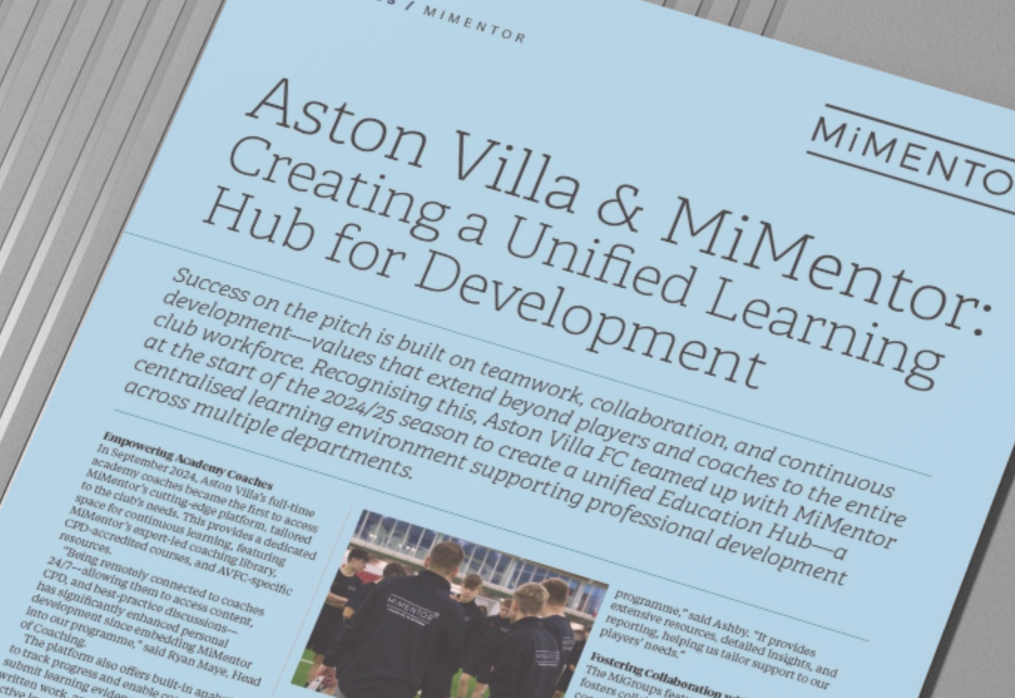
Aston Villa and MiMentor: Creating A Unified Learning and Development Hub

Success on the pitch is built on teamwork, collaboration, and continuous development – values that extend beyond the coaches and players to the entire club workforce. 

Recognising this, Aston Villa Football Club integrated MiMentor at the start of the 2024/25 season to create a unified Education Hub – an all-in-one learning environment designed to support the professional development of staff across multiple departments.

Empowering Academy Coaches

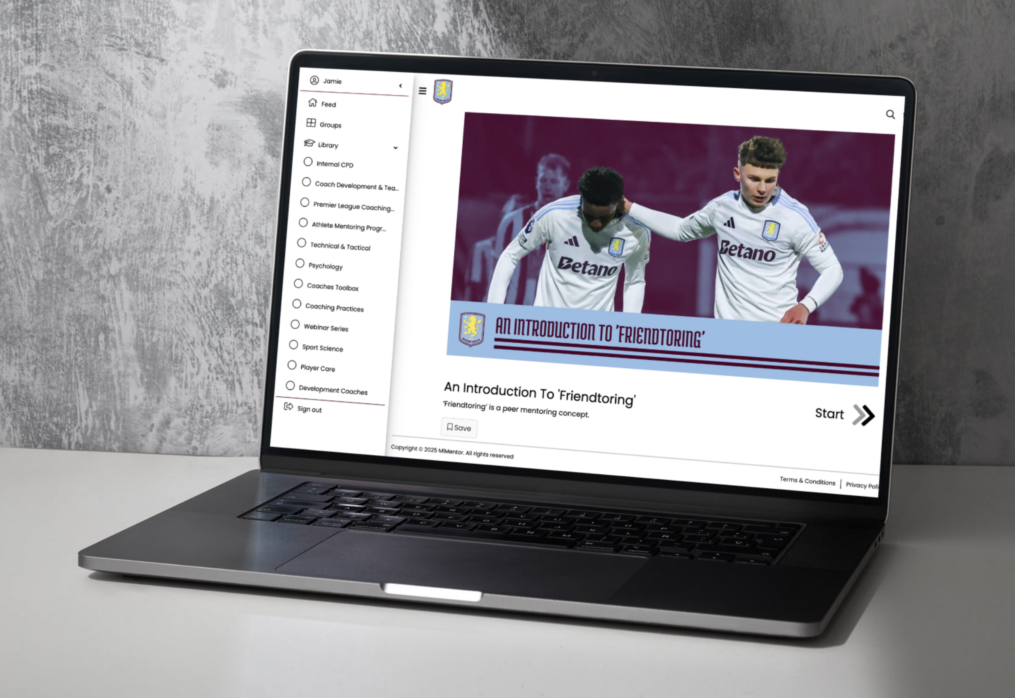
In September 2024, Aston Villa’s full-time academy coaches became the first to access a cutting-edge platform tailored to Aston Villa Football Club, powered by MiMentor, providing a dedicated space for continuous learning and professional growth. The platform integrates MiMentor’s expert-led holistic coaching library, giving coaches access to an extensive range of CPD-accredited courses and resources tailored to their development needs.

“Being remotely attached to your coaches 24/7, and for coaches to be able to access content and CPD, as well as being part of groups that share best practice and resources, at times of their choosing, has significantly enhanced personal development since we have embedded MiMentor into our programme,” said Ryan Maye, Aston Villa’s Head of Coaching.

The library hosts courses and resources from both MiMentor and AVFC with in-built analytics to track and monitor course progress and enable coaches to submit their evidence of learning through videos, written submissions, and other formats, enabling active learning and practical application.

Expanding Player Care and Development

Aston Villa’s Player Care Team is also utilising MiMentor to deliver structured curriculums tailored to different age groups. Through the platform, players can access essential educational content, ensuring holistic development beyond the pitch.

Additionally, the Athlete Mentoring Programme, a bespoke initiative supported by MiMentor, was introduced to assist U18 players. The two-year blended delivery with in-person workshops and online modules is an accredited programme by Associated Sports Qualifications (ASQ). It focuses on ‘Friendtoring’, a peer mentoring approach that encourages players to support and guide each other.

Player Education and Development – Supporting Apprenticeships and BTEC Pathways 

Aston Villa FC Head of Education, Ben Ashby, has been leveraging the MiMentor Platform to elevate the delivery of education curriculums across BTEC and apprenticeship programmes. Serving as a central hub for the club’s educational content, MiMentor ensures a structured and accessible learning experience for players navigating the demands of both football and academics.

“MiMentor has played a key role in delivering the Academy’s education programme,” said Ashby. “The platform provides a wealth of resources as well as detailed insights and reporting, which has been invaluable.”

MiGroups Collaboration and Sharing

MiMentor’s MiGroups feature, launched in 2024, fosters a collaborative learning environment. It allows coaches to share insights, discuss best practices, and engage with their peers – a feature that has already benefited organisations worldwide.

Meanwhile, players, parents, tutors, and club education staff can collaborate in real time, track progress with self-assessment targets, and share weekly updates. MiGroups enables clear communication, personalised support and helps all at the football club stay engaged in their development journey.

Future-Ready Learning Ecosystem: Expanding for the 2025/26 Season

By adding MiMentor to the club’s day-to-day development strategy, Aston Villa FC has established a future-ready learning environment, seamlessly integrating professional education for coaches, staff, and players.

James Baker, Co-Founder of MiMentor, said, “The goal is to evolve the platform into a true club-wide learning hub, supporting professional development initiatives across all areas of the organisation.”

Reflecting on the first seven months supporting Aston Villa FC, Baker added, “We are thrilled with how we have been able to integrate and support Aston Villa FC and are excited for what the new season will bring.”

This forward-thinking approach, which has been showcased in FC Business Magazine, ensures that learning is not just an obligation but a strategic advantage, helping Aston Villa FC develop stronger coaches, more informed players, and a more connected, high-performing organisation.

For further information or to book your demonstration, please get in touch with us today, click here.

You can also learn more about the MiMentor Platform and what if can offer clubs, organisations and individuals, via ‘THE PLATFORM‘ link at the top of the page.

MiMentor and Aston Villa In FC Business

MiMentor and Aston Villa In FC Business

MiMentor and Aston Villa FC Featured in FC Business: Transforming Coach Education

MiMentor is featured in the latest FC Business magazine, showcasing our relationship with Aston Villa FC in revolutionising their coach education, staff training, and player development. The feature highlights how MiMentor’s cutting-edge digital learning platform is supporting one of England’s most historic football clubs in delivering high-quality, accessible education to coaches, players, and staff.

Click here to read the full feature in FC Business (page 23)

How Aston Villa is Maximising MiMentor

Aston Villa is using MiMentor in various ways to enhance learning and development across all levels of the club. From coach education and staff CPD to player development and apprenticeship support, the club is embedding digital learning into its long-term strategy. The platform’s MiGroups feature is playing a pivotal role in fostering collaboration, allowing different departments to share insights and track progress efficiently. This ensures that learning remains structured, engaging, and aligned with the club’s overarching philosophy.

What This Means for Football Clubs and Organisations

The success of MiMentor at Aston Villa underscores how digital learning can transform education in football. Whether you’re a professional club, grassroots organisation, or governing body, MiMentor offers a scalable and customisable solution to support:

  • Coach Education: Structured learning pathways for coaching qualifications and ongoing CPD.
  • Staff Development: A centralised hub for training programmes and internal learning.
  • Player Education: Resources tailored to developing young talent on and off the pitch.
  • Collaboration & Tracking: Tools like MiGroups to streamline communication and progress monitoring.

By adopting a digital-first approach, clubs and organisations can enhance learning efficiency, accessibility, and engagement, ensuring that education remains at the heart of development.

Discover how your club or organisation can benefit from the MiMentor Platform

If your club or organisation is looking to enhance its coach education, staff CPD, or player development through a dynamic digital learning platform, MiMentor is the perfect solution.

Contact us today to book a demo and see how MiMentor can transform your learning strategy, or click the links at the top of the page to find out more about the MiMentor Platform…

MiMentor Unveils NSG Partnership

MiMentor Unveils NSG Partnership

MiMentor and Surf Nation announce a groundbreaking partnership set to transform the coaching landscape for soccer clubs.